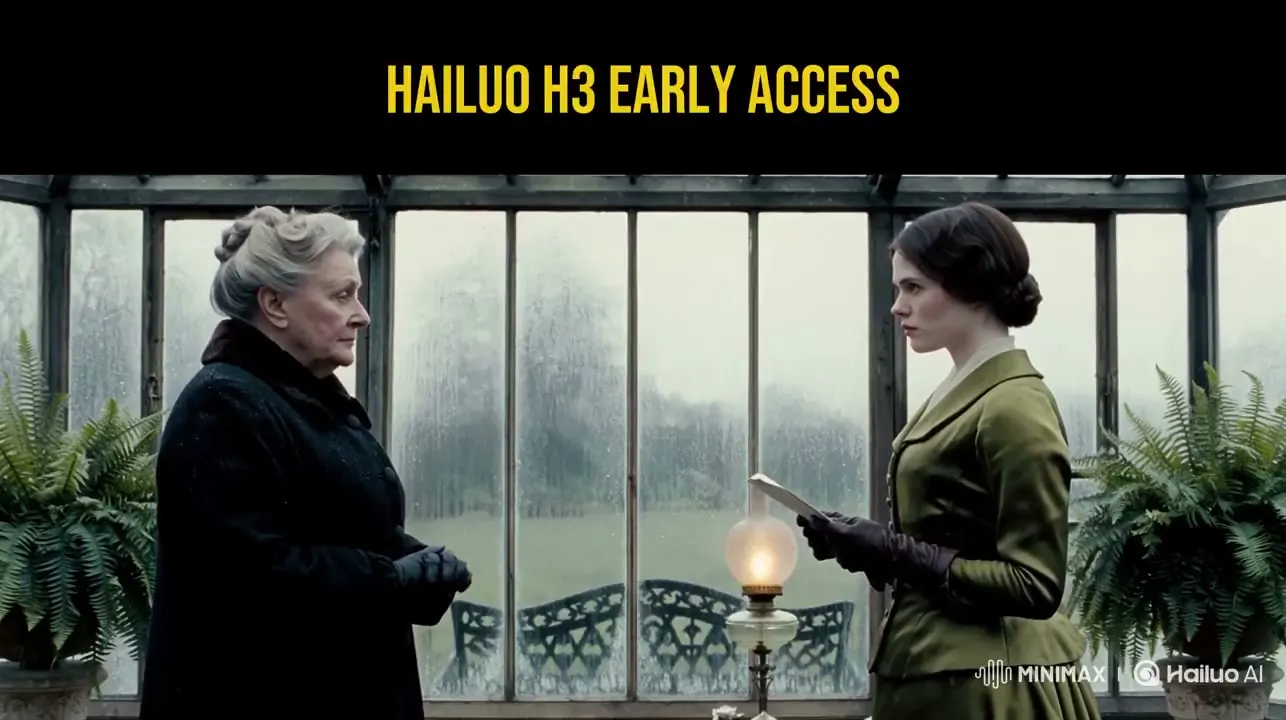
Recently in the AI video community, MiniMax H3 and ByteDance's Seedance 2.5 launched back-to-back, leaving many creators debating which should become their primary tool. But after extensive hands-on testing and side-by-side benchmarking, it really boils down to one simple takeaway: MiniMax H3 has a better grasp of what the final footage should "look like," while Seedance 2.5 focuses on what the director specifically asked it to "do."
When choosing models, many creators fall into the trap of looking for a black-and-white "winner." In a serious production environment, however, their relationship feels much more like two specialized roles collaborating on a film set rather than rivals fighting for first place in a single test.
Think of Seedance 2.5 as a technically sharp, hyper-obedient camera operator. Hand it a storyboard packed with complex blocking—pans, dollies, tracking shots, hard cuts, dynamic character actions, and even dozens of reference assets—and it will do everything possible to execute every instruction in the frame. This strict, mechanical adherence to prompts is essential for many commercial and studio pipelines. But when you push it past its limits with too many simultaneous constraints, it can struggle, leading to spatial misalignment, character distortion, or abrupt breaks in motion.
MiniMax H3, on the other hand, acts more like a post-production finishing team that guards overall aesthetic quality. Even if your camera prompts are cluttered, and it occasionally glosses over a tiny instruction or two, it fiercely protects baseline visual fidelity: faces do not distort, lighting stays cohesive, and color grading and commercial polish remain rock solid. One functions like an experienced finishing artist; the other behaves like an ultra-compliant virtual camera. This is not about one model rendering the other obsolete; it is a fundamental difference in technical design.
Architectural Approaches: Generalist Omnimodal vs. Industrial Division of Labor

To understand this gap between aesthetic polish and camera control, you first have to look at the underlying architecture of each model.
Seedance 2.5 follows a classic industrial-grade specialist approach. It uses a dual-branch Diffusion Transformer that treats video and audio together while decoupling spatial and temporal dimensions: the spatial layers ensure per-frame composition and structural integrity, while the temporal layers focus on multi-second narrative progression and fluid motion. This setup is built from the ground up to handle intricate camera moves and complex character blocking, giving it a very high ceiling for mechanical control.
MiniMax H3 takes an entirely different generalist path. It uses a unified H3-Omni Transformer to jointly process and interpret text, images, video, and audio. This end-to-end omnimodal architecture gives H3 native 32kHz stereo sound along with multilingual accented dialogue, producing very natural out-of-the-box audiovisual synchronization. Crucially, H3 chose open weights. Supported by chip makers and the open-source community from day one, creators can run it locally in ComfyUI to build their own private workflows—a massive advantage for teams needing customization.
To give a clear breakdown of their technical specifications, here is how the core parameters compare:
| Dimension | MiniMax H3 | Seedance 2.5 |
|---|---|---|
| Model Type | Open weights (supports local ComfyUI deployment) | Closed-source commercial model (official platform & API) |
| Single Generation Duration | Up to 15 seconds | Up to 30 seconds (supports multi-turn extension) |
| Resolution | Up to 2K by default (2560×1440) | Up to 1080p (longer durations require trade-off downscaling) |
| Reference Asset Limits | 9 images + 3 videos + 3 audio files (up to 12 files total) | 30 images + 10 videos + 10 audio files (up to ~50 files total) |
| Audio Performance | Native 32kHz stereo, multilingual accented dialogue | Joint audiovisual generation |
| Key Control Features | Inpainting/local editing, video-to-video motion transfer (V2V), Logo and text reproduction | 3D white model previs, green screen constraints, timestamp-precise editing |
According to blind test data published by Artificial Analysis in early August 2026, H3 demonstrates solid overall performance: it ranked #1 in video editing (with audio), #2 in text-to-video with audio, tied for #1 on the overall Arena leaderboard, and achieved the top spot among open-source models.
That said, specs on paper must be weighed against practical production constraints. In my testing, Seedance 2.5's advertised 30-second continuous shots usually required manually dropping the resolution to 720P to maintain stability. If you strictly require 4K commercial-grade output, you often still have to revert to version 2.0, which drops the single-generation duration back to 15 seconds. Meanwhile, H3 hits its sweet spot right at 15 seconds and 2K resolution, delivering directly usable, high-fidelity short clips without compromising visual quality.
Breaking Down the Costs: Different Pricing Models, Clear Cost Divide
For production teams generating high volumes of assets daily, the balance sheet often matters more than spec sheets when choosing tools.
It is worth noting upfront that pricing metrics across different channels are not standardized. Varying billing tiers, membership levels, and calculation methods mean benchmarks and user estimates vary significantly.
Looking at platform credits, generating a 15-second, 2K video with H3 on Hailuo costs around 180 credits. Running Seedance at the same specifications burns roughly 750 credits—a nearly fourfold difference on the same platform.
Breaking down costs per second yields similarly varied numbers across tests: under 720P, 15-second conditions, H3 runs about 0.3 RMB/second, Seedance 2.0 sits around 0.6 RMB/second, and 2.5 reaches roughly 1.2 RMB/second. Under official pricing, H3's 2K video comes in at 0.8 RMB/second—roughly one-third the price of comparable commercial flagships. Factoring in annual membership perks, H3's 2K generation cost can drop to around 0.5 RMB/second. In overseas API tracking, some have recorded its 2K cost at around $0.13 per second. On ByteDance's API side, 2.5 saw price adjustments compared to 2.0, with per-million-token pricing set at tiers such as 42 RMB or 70 RMB depending on whether video input is included.
While unit-cost calculations vary across sources, the commercial positioning is clear: Seedance 2.5 commands a premium as a closed-source industrial flagship suited for well-funded teams that prioritize strict execution; H3, whether deployed via cloud API or run locally on your own GPUs with ComfyUI, drastically lowers both initial trial costs and the barrier to scaling up production.
Real-World Testing: What Is Each Model Best at Shooting?

In my production workflow, neither model outright blows the other away across the board. In specific shots, their core strengths diverge completely.
Best Use Cases for Seedance 2.5
- Complex Narrative and Multi-Shot Extended Blocking: If you need a 30-second narrative sequence involving continuous camera moves (pans, tilts, dollies), character movement, and multiple shot-size transitions, 2.5 adheres more strictly to prompt instructions and reliably executes the scripted camera work.
- Strict Multi-Reference Constraints: When you have up to 50 character reference sheets, motion clips, and audio snippets that must strictly lock down character appearance, props, and costume consistency across shots, 2.5's massive input capacity is unmatched.
- Spatial Positioning with 3D White Models: By importing 3D blockouts (white models) or green-screen footage as geometric constraints, 2.5 locks down perspective and physical placement throughout complex spatial blocking, preventing visual continuity errors and eliminating the high cost of rerolling prompts.
Best Use Cases for MiniMax H3
- E-Commerce Ads, Brand Spotlights, and Motion Graphics: Commercial video cannot tolerate muddy or artifact-ridden visuals. H3 excels at rendering brand logos and printed packaging typography with clean lighting, making its direct 15-second outputs immediately viable for commercial use.
- Micro-Expressions, Talking Heads, and Dramatic Close-Ups: Thanks to its unified omnimodal architecture with native audio and multilingual accents, H3 delivers impressive results for emotional nuance in close-ups, subtle facial micro-expressions, and lip-sync alignment—making it ideal for talking-head content, digital avatars, and dialogue-driven short-form drama.
- Motion Graphics, Anime/Stylized Visuals, and Motion Transfer (V2V): In my practical testing on Motion Graphic animations, anime PVs, and live-action motion transfers, Seedance 2.5 frequently struggled to balance creative fluidity with strict control. H3 clearly performed better at maintaining stylized aesthetics and smooth, coherent motion.
Recommendations for Creators
At this stage of technology, no single model can reliably generate a flawless, cinema-ready masterpiece purely from a text prompt. When deciding between these two tools, I recommend dividing tasks according to your production pipeline:
- Go with Seedance 2.5 exclusively if: Your final video relies heavily on strict script execution, complex camera choreography, and long-range narrative continuity, or if you are producing studio-grade Previs. Paying the premium in unit price and compute is worth it for that level of blocking control.
- Go with MiniMax H3 exclusively if: Your projects focus on fast-paced clips under 15 seconds—such as e-commerce ads, brand intros, game UI motion demos, dialogue close-ups for short dramas, or stylized anime visuals. You need high-end visual polish on first glance, ready-to-use synchronized audio, high generation volumes on a tight budget, or a local private workflow built in ComfyUI.
- Use both collaboratively (my top recommendation): In a comprehensive production pipeline, start with Seedance 2.5 alongside 3D white models for wide environmental setup, large-scale long-shot blocking, and multi-reference character design locks. Then hand off character close-ups, localized cleanup/inpainting, motion transfer, and dialogue scenes requiring accurate lip sync to MiniMax H3.
Knowing which model directs the camera and which guards visual fidelity—and assigning tasks to each based on your shot list—is the most practical way to spend your production budget where it counts.
Sources
- Xin Pi Dan, "MiniMax H3 vs. Seedance 2.5: One Knows Post-Production, the Other Acts Like an AI Director," https://zhuanlan.zhihu.com/p/2067005073998209462
- Chen Da, "Reviewing the Newly Released MiniMax H3 from July 31, 2026," https://www.zhihu.com/question/2066529959200527973/answer/2067975588225225528
- Navis Li, "Seedance 2.5 and MiniMax H3 Released Together: Which Model Performs Better?" https://www.zhihu.com/question/2066531145517195395/answer/2068777121938510351
- Yiyu Observation, "Beyond Underpricing Seedance 2.5: MiniMax H3 Needs a Longer-Term Strategy," https://zhuanlan.zhihu.com/p/2070289096493250463
- Crazy Masker, "How to Choose Between MiniMax H3 and Seedance 2.5? Pixpix Lets You Have Both," https://zhuanlan.zhihu.com/p/2066950158202442741
- Yitao Ji (JZCreative), "After Burning 200,000 Credits, Here Is My Money-Saving Guide for Seedance 2.5 and MiniMax H3," https://zhuanlan.zhihu.com/p/2076620194454181351
- Data & AI Enthusiast, "The First Open-Source Model to Top the Global Video Leaderboard: MiniMax H3 Model Report," https://zhuanlan.zhihu.com/p/2070615871941301596
- stormzhang, "August 2026: My Latest AI PC Build Guide," https://zhuanlan.zhihu.com/p/2070110079613982646
- Ma Huhu, "Seedance 2.5 and MiniMax H3 Released Together: Which Model Performs Better?" https://www.zhihu.com/question/2066531145517195395/answer/2070102593620256262
- Zhiliao Youth, "How to Evaluate MiniMax's Recently Released H3 Model?" https://www.zhihu.com/question/2066451520716125558/answer/2066551315921211609
- waterwu, "How to Evaluate MiniMax's Recently Released H3 Model?" https://www.zhihu.com/question/2066451520716125558/answer/2066517263184818351
- Smart Hardware Hub, "MiniMax H3 and Seedance 2.5 Face Off on the Same Day: Who Truly Understands Commercialization?" https://zhuanlan.zhihu.com/p/2067340406011045222
- Lieyun.com, "Domestic Foundation Models Make Their Move Together," https://zhuanlan.zhihu.com/p/2068068956762645133